We are a highly professional and experienced suppliers of honeycomb machine, honeycomb core machine, honeycomb panel machine in China.
Author: Site Editor Publish Time: 2026-08-21 Origin: Site


Manufacturers face constant pressure to cut freight weights and material expenses. Maintaining structural integrity and perceived product quality remains non-negotiable. Traditional solid cores, like medium-density fiberboard (MDF) and particleboard, maximize durability but add massive shipping weight. They also introduce ergonomic hurdles during assembly and transit, slowing down production lines and increasing worker fatigue. Standard corrugated materials offer a lightweight alternative but consistently fail to deliver the compression strength needed for load-bearing applications or heavy transit protection.
Engineered kraft paper honeycomb bridges this gap. It serves as a high-strength-to-weight alternative, functioning effectively as both lightweight packaging and a robust structural manufacturing component. By leveraging biomimicry, this material provides exceptional vertical crush resistance while stripping away unnecessary mass. Transitioning to this engineered substrate allows manufacturers to optimize supply chains, reduce fuel consumption during transit, and maintain the rigid tolerances required for high-quality product assembly.
Unmatched Strength-to-Weight Ratio: Hexagonal cell structures provide superior vertical compression strength compared to traditional corrugated boards, reducing overall product weight by up to 60% versus solid wood cores.
Application Versatility: Serves dual purposes as a rigid internal substrate for interior doors/panels and as heavy-duty transit protection for palletized goods and bulk containers.
Manufacturing Adaptations Required: Successful integration requires specific veneering processes, internal framing for hardware retention, and moisture-controlled storage.
Logistical ROI: Higher initial material costs in some regions are offset by significant reductions in freight fuel consumption, increased payload capacity, lower handling-related injury rates, and streamlined export compliance.
The hexagonal cell structure is a marvel of natural engineering applied to industrial manufacturing. When we look at a sheet of honeycomb paperboard, we see a continuous web of kraft paper formed into uniform hexagons. This geometry excels at distributing vertical loads across the entire surface area. If you place a heavy weight on a flat honeycomb panel, the interconnected walls prevent localized crushing. The vertical orientation of the paper fibers resists shear forces, keeping the panel dimensionally stable under dynamic stress. This rigidity is exactly what you need for precision manufacturing and heavy-duty load bearing.
Material specifications dictate performance. Buyers must evaluate custom-engineered kraft paper grades based on their specific production needs. Virgin kraft fibers offer higher tensile strength and moisture resistance, making them ideal for structural components. Recycled kraft paper improves sustainability metrics and works well for void fill or transit packaging. Outer liner grades determine the panel's bending stiffness. Thicker, high-gsm liners prevent puncturing and provide a stable face for laminating. Cell sizes typically range from 10mm to 25mm. A 10mm cell size increases the board's density and crush resistance, creating a smooth, rigid surface perfect for veneering. A 20mm cell size reduces weight and material usage, suiting thick packaging applications. Strict thickness tolerances, often within +/- 0.2mm, must be maintained so the panels feed seamlessly into automated edge banders and CNC routers.
Comparing honeycomb to corrugated cardboard reveals distinct engineering differences. Both use paper, but their structural applications diverge. Honeycomb outperforms standard corrugated cardboard in vertical crush resistance. Corrugated flutes run horizontally. Under sustained vertical pressure, those flutes buckle and collapse. Honeycomb cells stand vertically, offering superior multi-directional stability. The panel resists bending along both the X and Y axes. This structural advantage makes honeycomb highly cost-effective for rigid, load-bearing applications where heavy-duty corrugated would fail or require excessive, costly layering.
Material Performance Comparison
Performance Metric | Engineered Honeycomb | Heavy-Duty Corrugated |
|---|---|---|
Vertical Crush Resistance | Exceptionally High (up to 400 kPa) | Moderate (Prone to flute collapse) |
Multi-Directional Stability | High (Rigid on X and Y axis) | Low (Bends easily along flute lines) |
Weight-to-Strength Ratio | Optimal for load-bearing structures | Adequate for standard boxing |
Surface Flatness for Veneering | Excellent (with 10mm-12mm cell size) | Poor (Flute lines telegraph through veneer) |
Impact Absorption | High (Predictable sequential crushing) | Moderate (Limited deceleration zone) |
Transitioning to lightweight components requires clear success criteria. Manufacturers usually target specific weight reductions, aiming to cut panel weight by 40% to 60% compared to solid particleboard. Assembly teams experience immediate ergonomic benefits. Handling lighter components reduces workplace strain, lowers injury rates, and accelerates production lines. Integrating lightweight honeycomb furniture components allows brands to design substantial, thick-looking shelves, desks, and wardrobes without the prohibitive weight of solid timber or MDF. Thick panels are aesthetically pleasing to consumers, but manufacturing them from solid MDF makes them nearly impossible to ship economically.
The mass production model relies heavily on flat-pack efficiency. Standardizing panel thickness optimizes warehousing space and maximizes shipping volume per container. Implementing honeycomb paperboard for IKEA style assembly allows manufacturers to scale output rapidly. The lightweight core means consumers can easily transport and assemble large furniture pieces themselves. This model depends on precise edge banding and pre-drilled internal framing. Factory lines insert solid wood or MDF rails along the edges of the honeycomb core before pressing the outer skins. This internal framing ensures the end-user can assemble the product using standard cam locks, dowels, and confirmat screws without crushing the hollow core.
Fine furniture production utilizes honeycomb differently than mass-market flat-packs. Wood glue-up panels require a specialized veneering process. Manufacturers press high-quality wood veneers or high-pressure laminates (HPL) over a honeycomb core framed with solid timber edges. This creates flat, highly stable structural panels that resist warping better than solid wood. The result mimics solid timber perfectly. Utilizing honeycomb paperboard for furniture in high-end applications demands precise adhesive application. Operators must calibrate press pressures accurately to avoid telegraphing the hexagonal cell structure through the thin wood veneer.
Structural integrity depends on specific load-bearing limits. Honeycomb panels exhibit different deflection rates compared to MDF and particleboard. Solid boards outperform honeycomb in extreme point-load scenarios, such as bolting heavy machinery to a small footprint. For distributed loads like tabletops, shelving, and side panels, honeycomb meets and often exceeds consumer durability expectations. The key is matching the cell size and liner thickness to the anticipated load. A 15mm cell with a 170gsm liner will prevent a bookshelf from bowing under the weight of heavy textbooks over time.
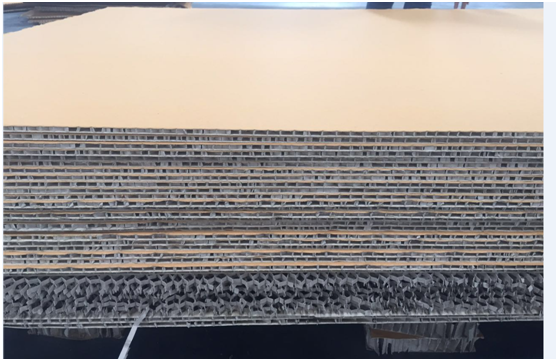
Interior doors require specific acoustic and thermal properties. Evaluating the sound transmission class (STC) ratings reveals how well the core blocks noise between rooms. The trapped air within the hexagonal cells provides excellent thermal resistance, preventing heat transfer between climate-controlled spaces. Using honeycomb core for door filling offers comparable performance to tubular chipboard at a fraction of the weight. This massive weight reduction extends the lifespan of door hinges and hardware. Lighter doors do not sag over years of use, reducing warranty claims and maintenance callbacks for builders.
Impact resistance relies heavily on surface stability and cell density. The chosen cell size directly impacts the surface quality of the door skin. Smaller cells provide more contact points for the door skin, preventing telegraphing. Telegraphing is the appearance of visible core lines or dimples under high-gloss finishes or thin veneers. A dense honeycomb core absorbs blunt impacts, preventing the outer skin from cracking or denting during normal household use. Manufacturers often specify 10mm or 12mm cell sizes for premium doors to ensure a flawless, glass-like finish after painting.
Bonding door skins to the core dictates production speed and quality. Cold press and hot press methodologies both work effectively, provided operators calibrate the equipment. Press pressure must be carefully monitored. Excessive force will crush the paper cells, compromising the door's structural integrity and creating uneven surfaces. Optimal glue spread rates, typically between 120 and 150 grams per square meter, prevent core saturation. Applying too much water-based adhesive causes the kraft paper to swell and warp. Open assembly times must align strictly with the adhesive manufacturer's specifications to ensure a permanent, void-free bond between the skin and the core. Factory teams must also insert solid lock blocks and hinge reinforcements into the core layout before pressing, ensuring carpenters have solid material to drill into during installation.
High-value case goods require robust transit protection to survive modern logistics networks. Custom-cut honeycomb functions exceptionally well as edge protectors, void fill, and corner boards. These components absorb kinetic energy and prevent transit damage during rough handling by forklifts or automated sorting equipment. Utilizing honeycomb paperboard for furniture packing ensures products arrive intact without adding excessive gross weight to the shipment. Keeping the gross weight low keeps freight classifications favorable, directly impacting the bottom line.
Palletized shipping demands reliable intermediate layers to prevent product crushing. Honeycomb panels function perfectly as top boards and tier dividers. They prevent strap damage by distributing tension evenly across the top of the load when warehouse workers ratchet down securing straps. When stacked in warehouses, these intermediate layers distribute weight evenly across fragile loads. This prevents the bottom tiers of cartons from collapsing under the vertical pressure of the pallets stacked above them.
Heavy-duty export scenarios require packaging that can withstand prolonged transit and varying climates. Bulk containers utilize honeycomb for structural rigidity, replacing heavy wooden crates. A major logistical advantage is that honeycomb paperboard for protective packaging is entirely exempt from ISPM-15 regulations. Unlike solid wood pallets and crates, paperboard requires no heat treatment or fumigation certificates. This exemption streamlines international customs clearance, preventing costly delays and quarantine fees at ports of entry.
Protecting fragile goods requires materials that absorb kinetic energy effectively. Honeycomb achieves this by crushing predictably upon impact. The cells collapse sequentially, decelerating the product before the destructive force reaches it. In standardized drop tests, honeycomb matches or exceeds the performance of traditional expanded polystyrene (EPS) foam. It offers a vastly superior sustainability profile, replacing petroleum-based foams with a fully recyclable paper alternative that breaks down easily in standard municipal recycling streams.
Calculating the return on investment for logistics hinges on weight reduction. Lowering the tare weight of packaging and products translates directly to significant fuel savings across the supply chain. Lighter shipments allow companies to drop into lower shipping tier costs with parcel carriers. Reducing the bulk of protective packaging increases the number of units that fit into a standard shipping container. Optimizing the freight spend per unit maximizes profit margins, especially for high-volume manufacturers shipping globally.
Environmental compliance increasingly drives material selection in manufacturing. Utilizing 100% recyclable, FSC-certified kraft paper helps organizations meet aggressive corporate ESG (Environmental, Social, and Governance) goals. European and North American regulators continue to implement stricter packaging waste regulations and extended producer responsibility (EPR) laws. Transitioning to paper-based honeycomb ensures compliance and avoids impending plastic taxes associated with EPS foam and polyurethane packaging materials.
Standardizing honeycomb procurement benefits multiple business units within an organization. The same material specified for furniture cores can be utilized to create point-of-purchase (POP) retail displays or temporary construction panels. This cross-industry versatility allows procurement teams to consolidate their purchasing. Driving up order volumes secures better bulk discounts from suppliers and simplifies inventory management.
Global availability of raw kraft paper remains highly stable, ensuring supply chain resilience. Lead times for custom cell configurations and specialized liner grades vary by region and manufacturer capacity. Mid-to-large scale manufacturers must assess the minimum order quantity (MOQ) expectations early in the sourcing process. Establishing reliable secondary suppliers for custom-cut honeycomb guarantees uninterrupted production during peak manufacturing seasons.
Integrating honeycomb into existing production lines presents unique fastening challenges. The hollow core cannot hold traditional wood screws or cam dowels. Manufacturers must integrate internal timber or MDF framing, known as rails and stiles, at specific hardware retention points. Alternatively, production lines can utilize specialized expansion anchors designed specifically for hollow core boards. Edge banding also requires a solid perimeter frame. The edge banding machinery needs a solid surface to apply pressure and adhesive. Without a solid edge, the banding will peel off, and the internal paper cells will be exposed.
Kraft paper degrades rapidly when exposed to high humidity or direct moisture. Warping, delamination, and complete structural failure occur if moisture penetrates the core before sealing. Warehousing raw honeycomb demands strict climate-controlled storage facilities. Manufacturers must monitor ambient humidity levels on the factory floor, keeping relative humidity (RH) between 40% and 60%. This is particularly critical during the pressing and veneering stages to prevent trapping moisture inside the finished panel, which leads to delayed warping after the product ships.
Transitioning to hollow core panels requires capital expenditure and process adjustments. Veneering over honeycomb requires precise calibration of press equipment. The pressure must be low enough to avoid crushing the core but high enough to ensure a permanent, even bond. Routing limitations also exist. Operators cannot route a deep decorative edge profile into a hollow panel without exposing the internal paper cells. Designs must be adapted to feature flat faces or utilize solid wood edge banding for profiled edges.
Request physical sample boards from suppliers to evaluate specific cell sizes and liner grades against your current solid core materials.
Conduct internal compression and drop tests to verify the material's transit protection capabilities for your heaviest product lines.
Run pilot adhesive compatibility trials to calibrate factory press pressures, ensuring you achieve a permanent bond without crushing the core.
Design and test internal framing templates to guarantee secure hardware retention points for end-user assembly.
A: Weight capacity depends on cell size, liner thickness, and internal framing. High-density honeycomb panels with thick kraft liners can support distributed loads exceeding 200 lbs, making them suitable for tabletops, shelving, and heavy-duty retail displays. Point-load capacity is lower than solid wood.
A: Honeycomb core offers comparable thermal and acoustic insulation (STC ratings) to tubular chipboard but at a significantly lower weight. This weight reduction prevents hinge sagging over time and makes the doors easier to transport and install, while maintaining excellent surface stability against impacts.
A: No. Standard screws will pull out of the hollow paper core. You must use internal timber or MDF framing at the fastening points during manufacturing, or utilize specialized hollow-core expansion anchors designed to grip the inner face of the outer liners.
A: Honeycomb provides superior vertical crush resistance compared to corrugated board and will not buckle along flutes. Compared to EPS foam, honeycomb absorbs shock equally well but is 100% recyclable, helping companies meet strict environmental compliance and ESG goals while avoiding plastic taxes.
A: No. Because honeycomb is an engineered paper product, it is entirely exempt from ISPM-15 regulations. It does not require heat treatment or fumigation, which streamlines international customs clearance and eliminates the risk of port delays associated with solid wood crates.
A: Standard kraft paper honeycomb is highly sensitive to moisture and will degrade in high humidity. However, it can be treated with specialized water-resistant coatings during manufacturing, or fully sealed within waterproof laminates and edge banding to protect the core in finished furniture.
A: MOQs vary by manufacturer and region but typically start around 1,000 to 2,500 square meters for custom cell sizes or specific liner combinations. Standard configurations are often available in smaller quantities or by the pallet through packaging distributors.