We are a highly professional and experienced suppliers of honeycomb machine, honeycomb core machine, honeycomb panel machine in China.
Author: Site Editor Publish Time: 2025-11-24 Origin: Site


Honeycomb cores are the unsung heroes of modern engineering, providing remarkable strength and stiffness with minimal weight. From aerospace structures to architectural facades, these materials make it possible to build lighter, stronger, and more efficient products. However, the performance of a honeycomb panel hinges on one critical parameter: core density.
This guide will walk you through everything you need to know about honeycomb core density, helping you make informed decisions for your specific application. By understanding the factors that influence density and following a structured selection process, you can optimize your design for strength, weight, and cost-effectiveness.
Table of Contents
1. What Is Honeycomb Core Density?
2. Why Choosing the Right Honeycomb Core Density Matters
3. Key Factors to Consider Before Choosing Honeycomb Core Density
4. How Cell Size Influences Honeycomb Core Density
5. How Foil Thickness Influences Honeycomb Core Density
6. Step-by-Step Guide: How to Choose Honeycomb Core Density
7. Recommended Density Ranges by Application
8. Low, Medium, and High Density Core Comparison
9. Common Mistakes When Choosing Honeycomb Core Density
Honeycomb core density is a measure of the material’s mass per unit volume. It is typically expressed in kilograms per cubic meter (kg/m³) or pounds per cubic foot (lb/ft⊃3;). This value tells you how much material is packed into the core structure, which directly influences its mechanical properties and overall weight.
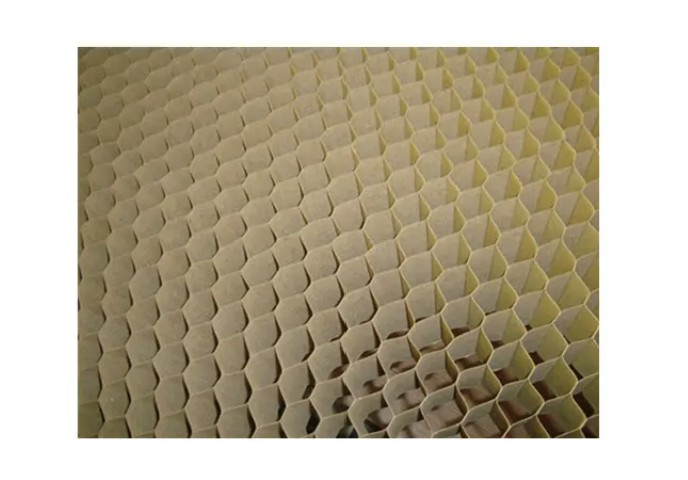
Paper Honeycomb Core for Door Filling
Three main factors determine the density of a honeycomb core:
Material: The inherent density of the material used to create the core (e.g., aluminum, Nomex, paper) is the starting point. Aluminum is denser than Nomex, which is denser than paper.
Foil Thickness: This refers to the thickness of the thin sheet or foil that forms the cell walls. Thicker foils result in a higher density because they add more mass to the structure.
Cell Size: This is the diameter of the individual hexagonal cells. Smaller cells mean more cell walls are packed into a given area, leading to a higher overall density.
In a honeycomb sandwich panel, the core’s primary role is to separate the two face sheets and resist shear forces. The density is crucial because it dictates the core’s ability to perform this function effectively. A well-chosen density ensures the panel can handle expected loads without bending, buckling, or failing, all while meeting weight targets.
Density varies significantly across different honeycomb materials:
Paper Honeycomb: As the lightest option, paper cores typically range from 8 to 20 kg/m³. They are best suited for non-structural applications where weight and cost are the main priorities.
Nomex (Aramid) Honeycomb: Known for its high strength-to-weight ratio and fire resistance, Nomex core densities range from 32 to 128 kg/m³.
Composite/Fiberglass Honeycomb: These cores offer a good balance of properties, with densities typically falling between 24 and 96 kg/m³.
Aluminum Honeycomb: Aluminum cores provide excellent rigidity and strength, with densities ranging from 48 to 240 kg/m³, making them suitable for demanding structural applications.
The choice of honeycomb core density is not just a minor detail-it’s a critical decision that has a direct impact on the performance, weight, and cost of your final product.
Higher density cores are generally stronger and stiffer. The increased material in the cell walls provides greater resistance to compressive and shear forces. For applications subjected to significant loads, a higher density core is necessary to prevent deformation and ensure structural integrity.
Density is directly proportional to weight. In industries like aerospace, automotive, and marine, minimizing weight is a primary objective to improve fuel efficiency and performance. Selecting the lowest possible density that still meets strength requirements is key to achieving lightweight design goals.
Higher density cores use more raw material (thicker foil or smaller cells), making them more expensive. By carefully selecting a density that is not excessive for the application, you can achieve significant cost savings without compromising performance. This ensures material is used efficiently, avoiding over-engineering.
Too Low: A core with insufficient density may fail under load. This could manifest as crushing (compressive failure), shearing, or allowing the panel to deflect excessively. In critical applications, this can lead to catastrophic structural failure.
Too High: A core with excessive density adds unnecessary weight and cost. While it will be strong enough, the design will be inefficient, potentially making the product uncompetitive or impractical for its intended use.
Selecting the optimal core density requires a holistic approach that balances multiple engineering requirements. Consider these factors before making your decision.
First, determine the types and magnitudes of loads the panel will experience.
Compressive Strength: Will the panel be subjected to crushing forces? This is critical for flooring and support structures.
Shear Strength: Will forces act parallel to the panel’s surface, trying to slide the face sheets relative to each other? This is a primary consideration in most structural panels.
How rigid does the panel need to be? The span (distance between supports) and the core thickness play a significant role. A thicker core dramatically increases stiffness, which may allow for a lower density core to be used while still meeting deflection limits.
For many applications, weight is a deal-breaker.
Aerospace: Every gram counts. Lightweighting is essential for fuel efficiency and payload capacity.
Marine & Automotive: Reducing weight improves performance, handling, and fuel economy.
Façade Panels: Lighter panels reduce the load on the building’s structure and simplify installation.
The operating environment can degrade materials and affect performance.
Temperature: Will the panel be exposed to extreme heat or cold? Materials like aluminum and Nomex perform well at high temperatures, while some thermoplastics may soften.
Corrosion & Humidity: In marine or humid environments, corrosion resistance is vital. Properly treated aluminum or thermoplastic cores are excellent choices, whereas paper cores should be avoided.
Fire Rating: For applications in aerospace, public transport, and construction, fire resistance is often mandated by regulations. Nomex cores are inherently fire-resistant.
What is the budget for the project? High-performance materials like Nomex and titanium come at a premium. Balance the performance requirements with cost constraints to find a viable solution. Also, consider any manufacturing limitations that might affect your choice.
How much wear and tear will the panel endure? For surfaces prone to impacts, such as cargo bay floors or automotive body panels, a higher density core or a core with smaller cells will offer better impact resistance and energy absorption.
Cell size is one of the two main levers you can pull to adjust density and fine-tune performance. A smaller cell size means more hexagonal cells—and therefore more cell wall material—are packed into a given volume, leading to a higher density.
Cores with small cells are dense and robust. The closely spaced cell walls provide excellent support for the face sheets, resulting in high compressive and shear strength. This makes them ideal for high-stress applications or when a very smooth surface finish is required on thin face sheets.
This is the sweet spot for many applications. Medium cell sizes offer a good compromise between strength, weight, and cost. They provide ample structural performance for a wide range of uses, from architectural panels to transportation interiors, without the weight penalty of smaller cells.
Large cells result in a lower density core, making them the lightest and most cost-effective option. While their mechanical strength is lower, they are perfect for non-structural or lightly loaded applications where weight reduction is the primary goal, such as decorative partitions, furniture, and packaging.
For high-load structural components, choose a small cell size.
For general-purpose panels, a medium cell size is often the best choice.
For lightweight, non-structural uses, a large cell size will save weight and cost.
Alongside cell size, foil thickness is the other critical variable that determines core density. A thicker foil adds more mass to each cell wall, directly increasing the overall density of the core.
Cores made with thin foils are lighter and less expensive. They are suitable for applications where structural demands are moderate and weight savings are a priority. However, they are more susceptible to damage during handling and fabrication.
This range provides a versatile balance of strength, weight, and durability. Cores with medium-thickness foils are robust enough for many structural applications while remaining relatively lightweight. This is a common choice for industries like transportation and construction.
Thick foils create a high-density, high-strength core. The robust cell walls offer maximum compressive and shear strength, making these cores ideal for the most demanding applications, such as high-performance aerospace components or impact absorbers.
Your choice of foil thickness should be based on a careful analysis of your project’s specific needs.
If strength is the top priority, select a thicker foil.
If weight and cost are the main constraints, opt for a thinner foil.
Combine foil thickness with cell size to achieve the precise density and performance characteristics your application requires.
Navigating the selection process can be straightforward if you follow a structured approach.
Step 1-Define Your Application Requirements: Start by clearly listing all performance criteria: load types (compressive, shear), weight limits, environmental exposure, fire resistance, impact durability, and budget.
Step 2-Identify Material Type: Based on your requirements, choose a core material. Is it a fire-critical aerospace application (Nomex)? A wet marine environment (thermoplastic or aluminum)? Or a cost-sensitive interior part (paper)?
Step 3-Select a Base Density Range: Using manufacturer datasheets, identify a preliminary density range for your chosen material that aligns with your strength needs.
Step 4-Adjust Density by Cell Size + Foil Thickness: Fine-tune the density by selecting a specific combination of cell size and foil thickness. Remember the trade-offs: smaller cells and thicker foils increase strength and density, while larger cells and thinner foils reduce them.
Step 5-Validate with Calculations: Perform engineering calculations to verify that the selected core, when combined with your chosen face sheets, will meet the required strength and deflection criteria. Finite Element Analysis (FEA) can be a powerful tool here.
Step 6-Check Standards and Testing Requirements: Ensure your selection complies with relevant industry standards (e.g., aerospace, building codes). Plan for physical testing of prototypes to validate your calculations and confirm real-world performance.
While every project is unique, here are some general guidelines for honeycomb core density in common applications:
Architectural Panels & Facades: Medium-density aluminum cores are popular for their balance of stiffness, low weight, and cost.
Cleanroom Walls and Ceilings: Lightweight, medium-density aluminum cores are used for their smooth, non-porous surfaces and structural stability.
Transportation Interior Panels (Bus, Train, Ship): Low to medium-density Nomex or thermoplastic cores are chosen for their light weight, fire safety, and durability.
Automotive Body Panels & Energy Absorbers: Higher-density aluminum cores are often used for their excellent energy absorption and impact resistance.
Aerospace Structures: High-performance Nomex and aluminum cores with a wide range of densities are used, tailored to specific load requirements from lightly loaded interior panels to high-strength wing components.
Furniture & Displays: Low-density paper or thermoplastic cores are ideal due to their low cost and light weight.
| Feature | Low Density | Medium Density | High Density |
|---|---|---|---|
| Strength | Lower | Moderate | Highest |
| Weight | Lightest | Moderate | Heaviest |
| Cost | Lowest | Moderate | Highest |
| Application Fit | Non-structural, packaging, furniture | General purpose, architectural, transport | High-load structural, aerospace, impact |
| Advantages | Cost-effective, lightweight | Balanced performance and cost | Maximum strength and stiffness |
| Limitations | Lower mechanical properties | Heavier than low-density options | Most expensive and heaviest |
To avoid over-engineering, don’t choose a high-density core when a medium-density one will suffice. To avoid under-engineering, don’t prioritize cost and weight to the point of risking structural failure. Always validate your choice with data.
Choosing Based Only on Strength: Focusing solely on strength can lead to an unnecessarily heavy and expensive panel. Always consider weight targets.
Choosing Based Only on Price: Selecting the cheapest option without verifying its structural properties can lead to product failure and safety risks.
Ignoring Cell Size and Foil Thickness: Density is a result of these two variables. Understanding their relationship is key to optimizing your design.
Using a Single Density for All Projects: Every application has unique requirements. A one-size-fits-all approach leads to inefficient and poorly optimized designs.
Density is determined by the material’s properties, cell size, and foil thickness. Manufacturers provide this information on their datasheets. The general formula relates the mass of the material in a unit volume.
Yes, for a given material and core type, a higher density core will have higher compressive and shear strength.
Signs of insufficient density include excessive deflection under load, visible dimpling of the face sheets into the core cells (especially with thin skins), or outright structural failure (crushing or shearing).
Sometimes. Increasing the core thickness dramatically increases the panel’s stiffness (rigidity). This might allow you to use a lower-density core and still meet deflection requirements, often resulting in a lighter and more cost-effective panel.
Common tests include flatwise compression (to measure compressive strength), plate shear (to measure shear strength and modulus), and three-point or four-point bending tests on the final sandwich panel to confirm its flexural properties.
Choosing the right honeycomb core density is fundamental to successful product design. It’s a decision that directly influences strength, stiffness, weight, and cost. By following a methodical process—defining requirements, understanding material properties, and balancing the trade-offs—you can select a density that is perfectly tuned to your application.
This optimization is not just an engineering exercise; it’s what leads to better-performing, more efficient, and more competitive products. If you are ever in doubt, consult with an experienced honeycomb core supplier or a structural engineer. Their expertise can help you navigate the complexities and ensure you make the smartest choice for your project.